
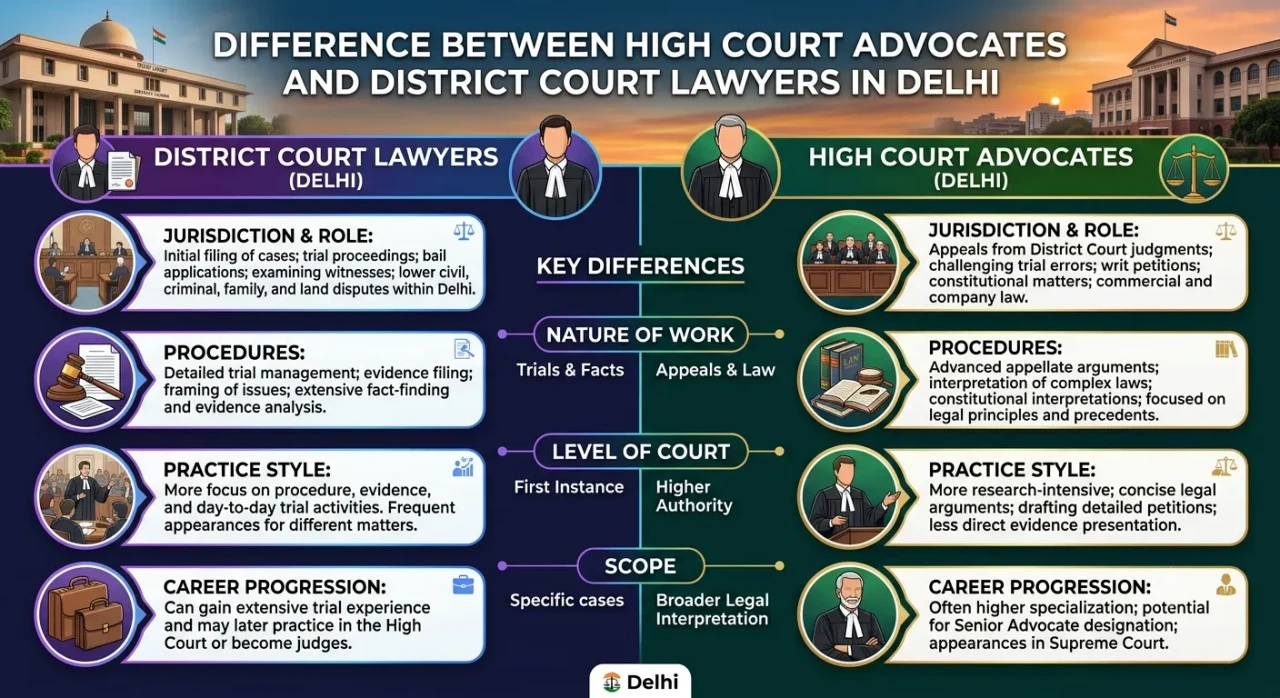
Understanding the difference between High Court advocates and District Court lawyers in Delhi is important when choosing legal help.Delhi has the Delhi High Court, which is a higher constitutional court, and several District Courts that handle cases within their own areas.
The best lawyer for your case depends more on the court where the case is being heard, the type of case, how far along the case is, and the lawyer's experience in that kind of legal work.
What Is a High Court Advocate?
A High Court advocate is a lawyer who regularly appears in cases before the High Court.
In Delhi, these cases may include appeals, writ petitions, revisions, bail matters, constitutional issues, commercial disputes, and other matters covered by the Delhi High Court.
The Delhi High Court also handles some cases as a trial court, meaning it can start legal proceedings instead of only reviewing decisions from lower courts.
What Is a District Court Lawyer?
A District Court lawyer represents clients in cases before Delhi’s lower or District Courts.
These courts deal with various legal cases such as civil, criminal, family, property, rent, commercial, and other matters according to their jurisdiction.
Delhi has several District Courts that are below the Delhi High Court in the court hierarchy.
High Court Advocate vs District Court Lawyer
The main difference usually lies in the court and the stage of the legal process in which the lawyer works.
Factor High Court Advocate District Court Lawyer
Main court Delhi High Court Delhi District Courts
Common cases Appeals, writs, revisions, High Court-related matters Trials, civil suits, criminal cases, and other matters from lower courts
Stage of legal process Often appellate or higher-level proceedings Often trial-level or initial court proceedings
Legal procedures High Court rules and related laws District Court rules and applicable laws
Choosing a lawyer Experience in High Court work and relevant topics Experience in District Court cases and the specific legal issue
This distinction isn't fixed.
A lawyer can work in both High Court and District Courts.For example, a Delhi High Court judge's background might mention work in the Supreme Court, High Courts, and District Courts.
Can the Same Lawyer Work in Both Courts?
Yes.
Being called a High Court advocate or a District Court lawyer doesn't mean they can only work in one court.A lawyer’s professional status follows the Advocates Act and other rules, while each court has its own rules and procedures for filing cases.
So, a lawyer who starts a case in a District Court might also help with an appeal or related matter in the High Court, as long as the rules and situation allow.
When Do You Need a High Court Advocate in Delhi?
A High Court advocate might be right when your case involves:
- A High Court appeal
- A writ petition
- A criminal revision or appeal
- High Court bail matters
- Quashing orders or other High Court criminal proceedings
- Constitutional or public-law issues
- Certain commercial or original proceedings
- Challenges to decisions from lower courts or authorities
Before filing, you must check the exact jurisdiction because not all cases can go directly to the High Court.
When Is a District Court Lawyer More Suitable?
A District Court lawyer is better when the case is mainly in a District Court, such as:
- Civil suits
- Property disputes
- Criminal trials
- Family matters
- Marital disputes
- Rent issues
- Evidence and witness proceedings
- Applications and temporary orders in the trial court
A lawyer who knows the District Court can help with filing documents, handling evidence, making court applications, and appearing in court.
Does Being a High Court Advocate Mean Being a Better Lawyer?
Not always.
The court level alone doesn't show how good a lawyer is.
For example, a District Court lawyer with lots of experience in property law might be better for a property case than an advocate who mainly handles appeals.
Similarly, an advocate with a lot of High Court experience may be better for a writ petition or an appeal.
The best choice is the lawyer who has the right experience for the type of case, the court involved, the stage of the case, and the legal issues.
How to Choose the Right Lawyer in Delhi
Before hiring a lawyer, think about these things:
Court involved: Find out if your case is in the District Court, Delhi High Court, or another court.
Case type: Look for a lawyer who has experience in the specific area of law related to your case.
Stage of case: Depending on whether your case is in trial, appeal, revision, bail, or writ proceedings, you might need a lawyer with different experience.
Relevant experience: Ask about their past work with similar cases.
Documents: Give the lawyer all important papers like court orders, notices, pleadings, and other records.
Procedure and fees: Make sure you understand what work the lawyer will do and how much they charge before starting.
The Delhi High Court suggests that if you're represented by a lawyer, you usually don’t need to go to court every time a matter is listed.
However, the lawyer must be there, and the court can ask for your personal presence if needed.
High Court and District Court Legal Help in Delhi
If your case is moving from a District Court to the Delhi High Court, or if you're unsure which court to go to, a lawyer can help you find the right court and process.
A lawyer can look at your case history, past orders, documents, and the relief you're asking for.
This helps them decide whether your case should be handled in a District Court, High Court, or another appropriate court.
Conclusion
The main difference between a High Court advocate and a District Court lawyer in Delhi is the court where they usually practice, the nature of the case, and the stage of the proceedings.
However, this isn't a strict rule, because lawyers can work in different courts.
Instead of choosing a lawyer just by their title, think about the specific court, the legal issue, the stage of your case, and the lawyer's experience.
This can help you find the best lawyer for your situation.
FAQs
1.
What is the main difference between a High Court advocate and a District Court lawyer?
The main difference is usually the court where they practice.
High Court advocates handle cases before the High Court, while District Court lawyers usually deal with trial-level and other lower courts.
2.
Can a District Court lawyer appear in the Delhi High Court?
Yes, but only if they follow the rules and meet the court's requirements.
Their experience in High Court cases should be considered when choosing a lawyer.
3.
Is a High Court advocate better than a District Court lawyer?
Not automatically.
The right lawyer depends on the case type, the court, the stage of the case, and their experience.
4.
Which lawyer should I choose for a property dispute in Delhi?
If your case is in the District Court, pick a lawyer with experience in property disputes there.
If it's an appeal or a High Court case, then look for High Court experience.
5.
Do I need a High Court advocate for an appeal?
If the appeal is in the High Court, it's better to choose a lawyer with experience in High Court appeals.
But first, make sure you know which court is handling the appeal.
6.
Can the same lawyer handle my District Court and High Court case?
Sometimes, yes.
A lawyer can work in different courts, but they must follow the rules and have experience in the relevant cases.
7.
How do I choose a lawyer in Delhi?
Think about the court, the type of case, the stage of proceedings, the lawyer's experience, past court orders, and the specific legal issues before picking a lawyer.