
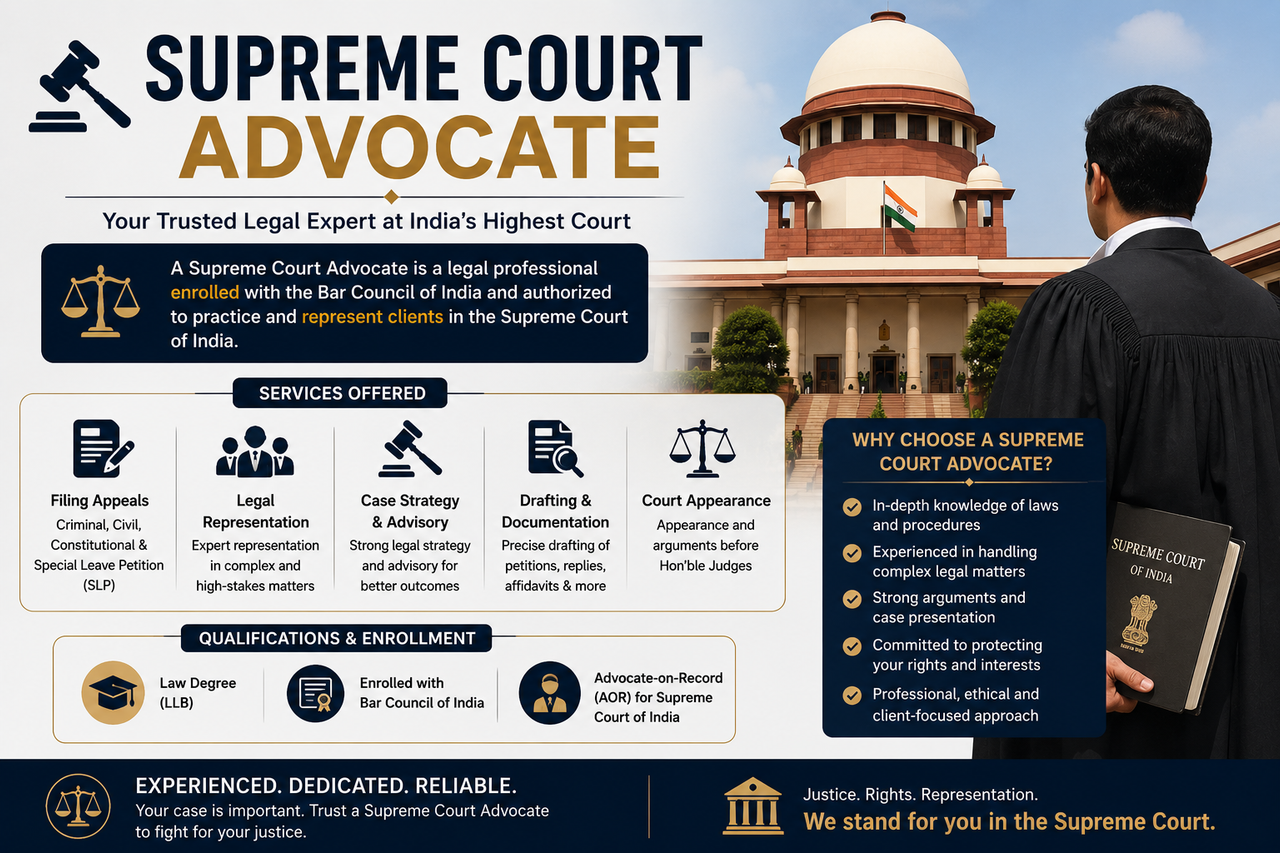
Supreme Court Advocate: Role, Fees, Eligibility and How to Choose One
A Supreme Court advocate represents clients in matters that go to the Supreme Court of India.
People may need a Supreme Court lawyer for criminal appeals, civil appeals, matrimonial disputes, bail matters, Special Leave Petitions (SLPs), constitutional cases, and other court proceedings.
However, not every lawyer can represent someone in the Supreme Court.
The type of case determines what kind of legal help is needed.
What Is a Supreme Court Advocate?
A Supreme Court advocate is a lawyer who works on cases that are heard in the Supreme Court of India.
These cases often involve complex legal issues, detailed procedures, and strict rules about how to file documents.Depending on the case, the legal team may include an Advocate-on-Record (AOR), an arguing counsel, and sometimes a Senior Advocate.
An AOR has specific duties related to handling and filing cases in the Supreme Court according to the rules set by the court.
What Types of Cases Does a Supreme Court Advocate Handle?
A Supreme Court lawyer may handle various kinds of cases, such as:
* Criminal appeals
* Civil appeals
* Special Leave Petitions
* Bail and anticipatory bail matters
* Matrimonial and family disputes
* Constitutional matters
* Property disputes
* Service-related issues
* Writ petitions
* Review petitions
* Transfer petitions
* Commercial disputes
The right lawyer depends on the subject of the case and how complicated it is.
When Do You Need a Supreme Court Advocate?
You may need a Supreme Court advocate if your case has reached the Supreme Court, or if you are considering challenging a judgment or order from the Supreme Court.
For instance, legal help might be needed after an adverse decision from a High Court, especially if a party believes there was a major legal mistake, a significant question of law, or another valid reason for the Supreme Court to get involved.
Not all cases have an automatic right to be appealed to the Supreme Court.
In some situations, a party may need to approach the court through a Special Leave Petition under Article 136 of the Constitution.
A lawyer can look at the judgment and advise on the best possible legal action.
What Is the Role of an Advocate-on-Record?
An Advocate-on-Record, or AOR, plays an important role in Supreme Court proceedings.
The AOR may be responsible for:
* Filing petitions and appeals
* Signing and submitting legal documents
* Filing applications
* Ensuring all procedures are followed
* Receiving communications from the Court
* Keeping the case record updated
* Organizing documents and filings
An arguing advocate or Senior Advocate may present arguments during court sessions, while the AOR takes care of the formal procedural tasks required by the Supreme Court Rules.
How Much Does a Supreme Court Advocate Charge?
There is no fixed fee for a Supreme Court advocate.
Legal fees can vary based on:
* The type of case
* How complicated the legal issues are
* The number of court hearings
* The amount of documents and evidence involved
* Whether an SLP or appeal is needed
* The lawyer’s experience and seniority
* The filing and procedural work involved
* How many advocates are involved
Therefore, it is important to get a clear fee structure from the lawyer before hiring them.
Court fees, document preparation, filing expenses, and other legal costs may be separate from the lawyer’s professional fees.
How to Choose the Best Supreme Court Advocate?
Choosing a lawyer should not be based only on ads or claims like "best Supreme Court lawyer."
Consider the lawyer’s:
1.
Relevant experience: Look for experience in the specific area of law related to your case.
2.
Supreme Court practice: Experience with Supreme Court procedures can be important for filing and conducting court proceedings.
3.
Case strategy: The lawyer should be able to explain the possible legal remedies and the realistic advantages and disadvantages of your case.
4.
Fee structure: Understand the professional fees and any additional expenses before you decide to work with the lawyer.
5.
Communication: Your lawyer should clearly explain important developments and procedural requirements.
6.
Case assessment: A responsible lawyer should not promise a particular outcome, as the final decision is made by the Court.
Supreme Court Advocate for Criminal Cases
Criminal cases in the Supreme Court can include appeals against a guilty verdict or a not guilty decision, questions about the sentence, bail issues, Special Leave Petitions and other criminal matters.
A Supreme Court criminal lawyer can look at the decisions from the lower court and High Court, find legal reasons, and advise if an appeal or SLP is the right option.
In criminal cases, important issues could include time limits, evidence, court procedures, how to interpret criminal laws, and whether the conviction or sentence was legally correct.
Supreme Court Advocate for Matrimonial Cases
Supreme Court advocates also deal with marriage and family law matters like divorce, support payments, child custody, domestic violence, and related issues.
In a family matter, the lawyer may examine the orders from the Family Court and High Court and decide if a Supreme Court action is possible.
For example, in cases about support, there may be questions about income, sharing financial details, children who need care, and the laws that apply.
Can a Supreme Court Advocate Guarantee a Win?
No lawyer can truthfully promise that a case will be won in the Supreme Court.
The result depends on the facts, what evidence is available, the law that applies, and how the Court sees things.
A good Supreme Court advocate should be honest about the case's strengths and weaknesses instead of making promises about the outcome.
Frequently Asked Questions
How do I find a Supreme Court advocate?
Look for a lawyer with experience in the area of law related to your case and knowledge of Supreme Court procedures.
The nature and complexity of the issue will help you choose the right person.
Can a High Court lawyer appear in the Supreme Court?
Advocates can appear before the Supreme Court as long as they follow the rules and procedures set by the Court.
An Advocate-on-Record has specific duties and responsibilities for appearing and filing in the Court.
What is an AOR in the Supreme Court?
AOR stands for Advocate-on-Record.
An AOR handles specific filing and procedural tasks in Supreme Court cases as outlined by the rules.
How much does a Supreme Court lawyer charge?
There is no set fee.
The cost depends on the type and complexity of the case, the lawyers involved, and the number of hearings and other procedural steps.
Can a Supreme Court advocate handle an SLP?
Yes.
A properly qualified legal team can prepare and present a Special Leave Petition, provided it follows the Supreme Court Rules and meets the case's requirements.
Conclusion
A Supreme Court advocate plays an important role when a legal issue reaches India’s top court.
Supreme Court cases need careful planning, the right legal approach, and following detailed procedures.
Whether it's a criminal appeal, a civil disagreement, a family matter, a constitutional issue, a bail request or a Special Leave Petition, it's important to choose the right lawyer based on the subject and requirements of the case.
If you are thinking about going to the Supreme Court, make sure to have your court order and full case records reviewed by a qualified legal professional before deciding on the best course of action.
Legal Disclaimer: This article is for general information only and does not provide legal advice.
The correct legal action depends on the facts, the applicable laws, and the court history of each case.