
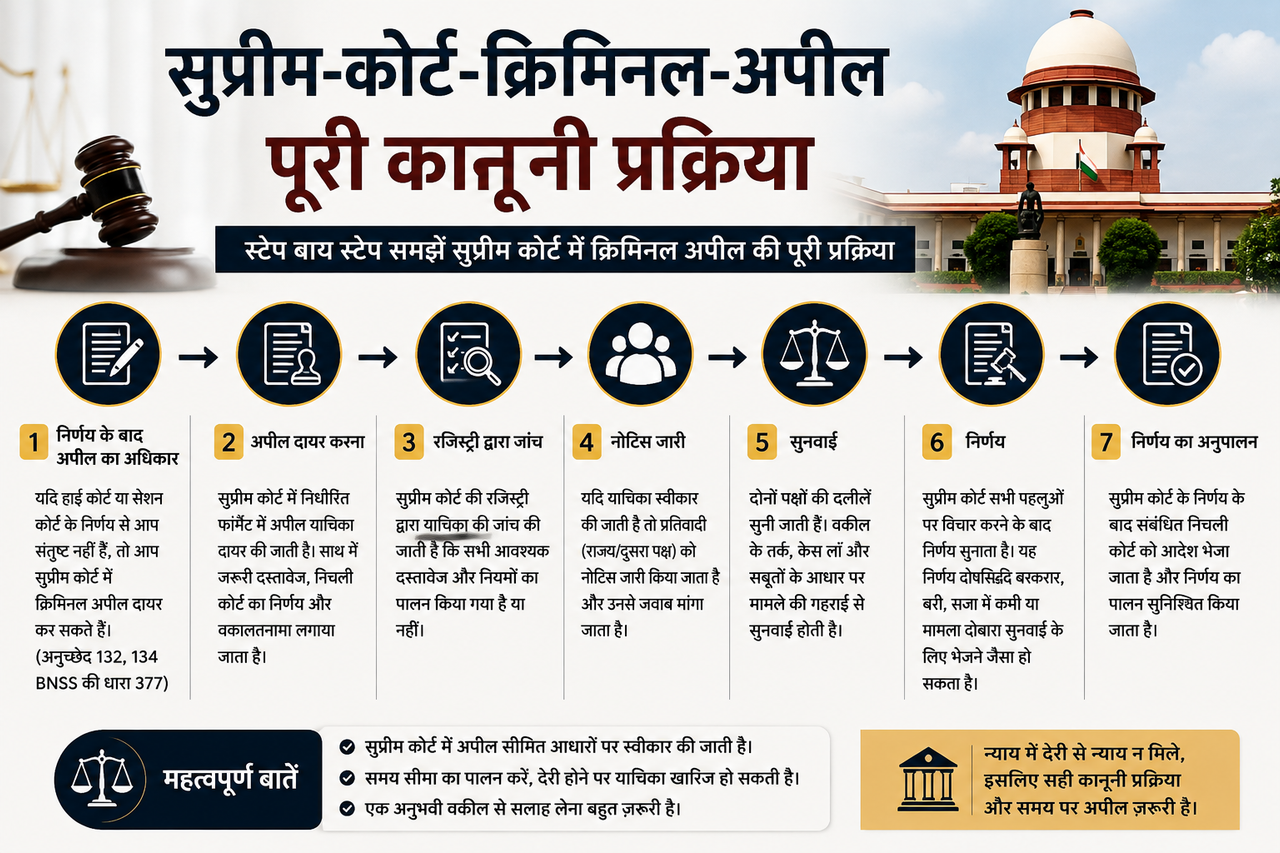
A criminal appeal to the Supreme Court is an important legal remedy for someone who is unhappy with a decision made by a High Court or another competent court.However, the right to directly appeal to the Supreme Court is not available in every criminal case.It depends on which court the case came from, the nature of the judgment, and the available legal route for appeal.
The Supreme Court hears serious legal and constitutional issues in criminal cases.
Therefore, it is necessary to thoroughly examine the case records, judgment, evidence, and available legal remedies before filing an appeal in the Supreme Court.
When Can a Criminal Appeal Be Filed in the Supreme Court?
There are different legal routes to approach the Supreme Court in a criminal matter.
In some cases, the provisions under Article 134 of the Constitution may apply for a criminal appeal.
In addition, the Supreme Court can also intervene through a Special Leave Petition (SLP) under Article 136 against a judgment, decree, determination, sentence, or order.
Article 136 gives the Supreme Court wide discretionary power.
However, an SLP is not an automatic right of appeal.The Court decides, based on the facts and circumstances, whether there is a need for intervention.
So, it is not correct to assume that every criminal case allows a person to directly appeal to the Supreme Court.
What is the Difference Between a Criminal Appeal and an SLP?
A criminal appeal and a Special Leave Petition (SLP) are not the same.
A criminal appeal is a statutory right available under certain laws, while an SLP under Article 136 is a process where the Supreme Court grants special permission to intervene.
If there is no direct right of appeal, the SLP route may be available depending on the circumstances.
Which remedy to choose depends on the judgment and applicable law.
The Full Procedure for a Supreme Court Criminal Appeal
1.
Review of the Judgment and Case Records
The first step is to conduct a detailed legal analysis of the challenged judgment or order.
This includes:
- Findings from the lower and high courts
- Evidence and witness statements
- Relevant legal provisions
- Procedural irregularities
- Important legal questions
- Basis of conviction or acquittal
- Sentence and other directions
2.
Determining the Appropriate Legal Remedy
Next, it is determined whether the case falls under:
- Criminal Appeal
- Special Leave Petition
- Review Petition
- Curative Petition
Each remedy has its own legal requirements and limitations.
3.
Preparing the Supreme Court Petition
After that, the advocate prepares the petition based on the facts, grounds, and legal arguments of the case.
In a criminal appeal, the grounds must be clear and it should be explained where there was a legal or constitutional error in the challenged judgment.
4.
Preparing Documents and Annexures
All necessary documents related to the case are attached with the petition.
These may include the judgment, orders, relevant pleadings, evidence-related documents, and other important records.Accuracy of the documents is crucial, as Supreme Court proceedings are largely based on the case records and legal grounds.
5.
Filing and Scrutiny
The petition is filed with the Supreme Court Registry.
The Registry checks the procedural requirements and compliance with the documents.If any defects are found, they must be corrected according to the prescribed procedure.
6.
Preliminary Hearing
The matter comes before the Supreme Court for a preliminary hearing.
At this stage, the Court may assess whether there are sufficient grounds for intervention.If it is an SLP, the Court may consider granting special leave first.
7.
Issuance of Notice and Further Hearing
If the Court considers the matter suitable for further hearing, it may issue a notice to the respondent.
Afterwards, the parties present their case through written submissions and oral arguments.
Final Judgment
After looking at all the submissions and records, the Supreme Court can give its judgment.
The court can either uphold, change, cancel, or send back the judgment from a lower court or High Court based on the situation.
What Happens to Bail and Sentence in a Criminal Appeal?
When a criminal appeal is filed, the conviction or sentence does not automatically stop.
If someone wants to get bail or have the sentence suspended, they may need to file the right application.
The court can decide based on the circumstances of the case, the sentence, the behavior of the accused, delays, merits, and other relevant factors.
So, it is important to understand that an appeal and a bail application are separate legal issues.
Why Is a Lawyer Important for a Criminal Appeal in the Supreme Court?
Criminal litigation in the Supreme Court can be very technical.
It is important to understand the correct remedy, time limits, procedural requirements, legal grounds, and relevant case laws.
An experienced Supreme Court criminal lawyer can help with:
* Analyzing the judgment legally
* Deciding on the correct remedy
* Preparing a criminal appeal or SLP
* Preparing the legal grounds
* Filing a bail or sentence suspension application
* Arguing in the Supreme Court
* Making sure all procedures are followed correctly
Conclusion
A Supreme Court criminal appeal is an important but technical legal remedy.
There is no automatic right to appeal to the Supreme Court against every criminal judgment.The correct legal route has to be determined based on Article 134, Article 136, and other applicable laws.
If a person wants to challenge a conviction, acquittal, sentence, or a High Court criminal judgment in the Supreme Court, it is important to review the judgment and complete case records to choose the right legal remedy.
Legal Disclaimer: This article is for general legal information only and should not be considered as personal legal advice.
The process for a criminal appeal can vary based on the facts of the case, the judgment, and the applicable laws.It is advisable to seek legal advice from a qualified Supreme Court lawyer for any specific matter.